On October 27, 2026, Polygon OMS rolled out spend caps for AI agents operating from on-chain wallets. For founders and finance leads running web3 payments, this isn't just another protocol upgrade. It's the moment AI agents become recognized as real counterparties—and the controls conversation shifts from human fraud risk to agent wallet permissions.
Table of Contents
- What just happened
- Why this matters now
- The background a finance lead needs
- How to run web3 payments today
- What are Web3 payments?
- What is an AI agent spend cap?
- What is Polygon OMS's new spend controls feature?
- Why do AI agents need wallet controls?
- How do Web3 payments work for startups and DAOs?
- What are the risks of agent-mediated payments?
- Where do fiat and crypto controls meet?
- What to watch next
- Key Takeaways
What just happened
Polygon OMS introduced a capability, reported by eGamers.io: teams can now cap what AI agents are permitted to spend from wallets they control. The mechanism grants an agent a scoped permission on an existing wallet, setting explicit boundaries on what the agent can move and how much.
This sits within the broader Polygon OMS payments infrastructure. The spend cap addition matters because it addresses a control gap that has widened as autonomous agents started holding and spending stablecoins for businesses.
Multi-signature wallets enforce who must approve a transaction. Agent spend caps enforce what an agent can do without asking. That's a fundamentally different control surface. A multi-sig requires human quorum; an agent spend cap acknowledges the agent will act autonomously and pre-commits a boundary. For a DAO treasury or Web3 startup's operating wallet, multi-sig can't scale to agents executing dozens of micro-transactions. Spend caps can.
Why this matters now
AI agents have moved from executing pre-scripted tasks to making independent spending decisions—paying for compute, settling data marketplace invoices, managing DeFi positions. When an agent holds a wallet key and initiates a stablecoin transfer, it acts as a counterparty, not a tool. A tool's output can be reviewed; a counterparty's actions require ex-ante boundaries. Polygon OMS's spend caps provide exactly that: programmable constraints applied before the agent moves assets.
For DAO treasury management, if a DAO authorizes an agent to manage yield strategies, the treasury manager now has a mechanism to say "allocate up to X USDC across these three protocols, and nothing more."
Traditional business payment controls assume a human requests, a human approves, a human reconciles. AI agents don't fit. An agent might trigger a payment at 3 a.m. based on a smart contract condition, with no human in the loop. That's the point—but it means the approval workflow built into most crypto payment controls evaporates. Agent spend caps offer a bridging mechanism: a programmable surrogate for the approval step that lives at the wallet level, not the org chart.
The background a finance lead needs
Agent spend caps sit within broader web3 payment infrastructure. The stack typically includes:
| Layer | What it controls | Example |
|---|---|---|
| Wallet permissions | Who holds keys and signs | Multi-sig, MPC wallets |
| On-chain rules | What transactions are valid | Smart contract access controls |
| Agent spend caps (new) | What autonomous agents can spend | Scoped limits per agent, per period |
| Off-chain treasury controls | How fiat and crypto operations are governed | KYB, corporate card limits, multi-factor auth |
| On/off-ramp | Conversion between crypto and fiat | Instant USDC-to-fiat conversion, wire settlement |
Agent spend caps sit between on-chain programmability and off-chain governance. They extend treasury controls into autonomous execution environments. Platforms like OneSafe, which provide crypto on-ramp off-ramp services alongside fiat accounts, pair naturally. The wallet-level cap governs what the agent can do on-chain; platform-level controls—KYB, MFA, Fireblocks custody—govern the human and organizational side.
DAOs feel this pressure first. Their treasuries are on-chain, spending decisions increasingly automated, contributors distributed. When a DAO deploys an agent to manage stablecoins or pay contributors, it immediately hits how to impose limits without a governance vote for every transaction. Blockchain payment security for agent-mediated transactions is becoming a DAO-level concern. The answer isn't abandoning automation—it's building spend caps that reflect treasury policy.
How to run web3 payments today

Don't treat wallet-level spend caps as your only defense. Pair them with off-chain controls at different points in the transaction lifecycle:
- Define the agent's scope: which protocols and assets, via smart contract permissions.
- Set maximum spend caps per agent per period: Polygon OMS's mechanism or equivalent programmatic limits—daily, weekly, per-transaction.
- Enforce KYB-anchored identity at the platform layer: the humans authorizing the agent wallet should be identity-verified through a platform requiring MFA. OneSafe's mandatory MFA and Fireblocks custody provide this layer.
- Reconcile agent-initiated transactions near real-time: log, categorize, flag anomalies like any automated disbursement.
Spend caps at the wallet layer prevent unauthorized outflows; treasury controls at the platform layer ensure the humans overseeing the agent are who they say they are. Both are necessary.
The crypto on-ramp off-ramp boundary is an underused control point. When an agent accumulates stablecoins that need to become fiat for payroll or vendor payments, the conversion event creates a governance checkpoint. Routing conversions through a platform applying compliance checks gives you an interception point: if the agent's on-chain activity doesn't match expected patterns, the off-ramp can be delayed, reviewed, or blocked. For businesses managing both self-custody wallet permissions and fiat accounts in one interface, this checkpoint is already built in.
What are Web3 payments?
Web3 payments use public blockchains, smart contracts, and crypto wallets instead of card networks or banking rails. They enable near-instant settlement, reduce cross-border friction, and remove intermediaries. Businesses use them to pay vendors in stablecoins, receive customer payments on-chain, and manage multi-currency treasuries.
What is an AI agent spend cap?
An AI agent spend cap is a programmatic limit on how much value an autonomous agent can transfer from a wallet it controls. Unlike multi-sig permissions governing who can sign, a spend cap defines what the agent is allowed to spend—typically per transaction, per period, or per protocol interaction. It functions as a pre-committed boundary without human intervention.
What is Polygon OMS's new spend controls feature?
Polygon OMS's feature, reported on October 27, 2026, lets teams assign an AI agent a scoped permission on an existing wallet. The team defines a cap, and the agent operates within it. It's part of the Open Money Stack.
Why do AI agents need wallet controls?
Agents act as autonomous counterparties, not passive tools. An agent that can sign transactions without oversight can drain a wallet if instructions are flawed or malicious. Spend caps create ex-ante boundaries—limits set before the agent acts—rather than post-hoc review, which comes too late for on-chain finality.
How do Web3 payments work for startups and DAOs?
Startups and DAOs hold assets in self-custody wallets, execute via smart contracts, and connect to fiat banking through on/off-ramps. A startup might pay a contractor in USDC on Polygon, then convert the remaining balance to USD for payroll. A DAO might run contributor payments through a multi-sig. The web3 payment gateway layer handles the handoff between crypto rails and fiat banking.
What are the risks of agent-mediated payments?
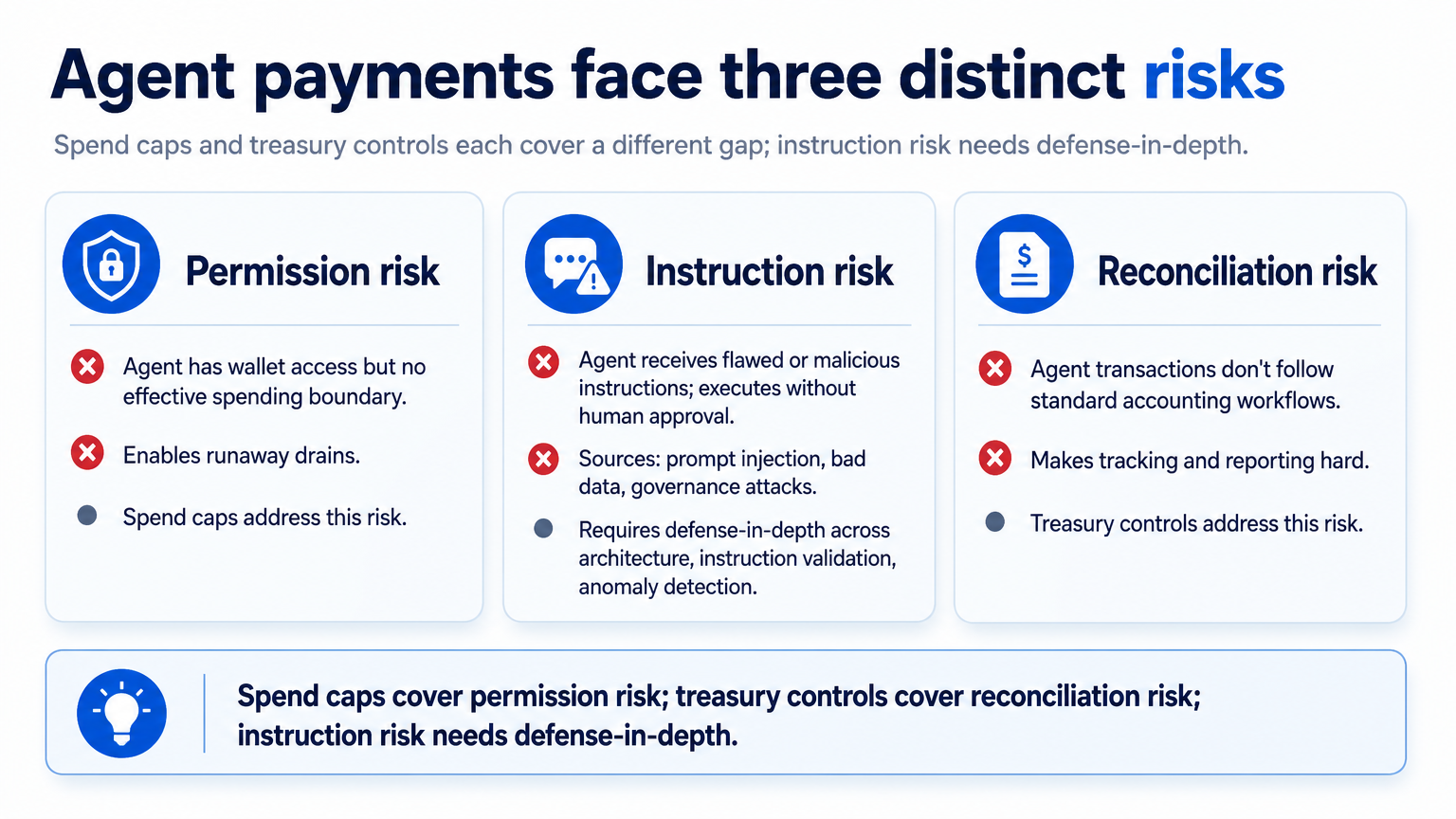
- Permission risk: the agent has wallet access but no effective spending boundary, enabling runaway drains.
- Instruction risk: the agent receives flawed or malicious instructions—from prompt injection, bad data, or governance attacks—and executes because no human approval step catches the error.
- Reconciliation risk: agent-initiated transactions don't follow standard accounting workflows, making tracking and reporting hard.
Spend caps address permission risk. Treasury controls address reconciliation risk. Instruction risk requires defense-in-depth across agent architecture, instruction validation, and anomaly detection.
Where do fiat and crypto controls meet?
They meet at the on/off-ramp boundary and the identity layer. When stablecoins become fiat, the business routes through a platform applying compliance checks, MFA, and custody controls. OneSafe handles this convergence: the on-chain agent operates within its spend cap, while human-governed treasury accounts apply crypto payment controls. The stack: on-chain agent wallet with spend caps; conversion layer with compliance checks; fiat layer with segregated accounts and wire controls. Spend caps alone don't cover the conversion and fiat layers; treasury controls alone don't cover autonomous on-chain execution.
To keep your team's documentation and blog updated as these controls evolve, consider a service like Joyrise, which plans, writes and publishes illustrated SEO articles to your Webflow blog daily.
What to watch next
- Adoption by other L1/L2 ecosystems. Polygon OMS has first-mover announcement; watch for similar features on Solana, Base, and Arbitrum.
- Integration with DAO governance frameworks. Spending caps modifiable through decentralized governance votes, not just admin keys.
- Regulatory attention to agent-initiated transactions. Regulators may ask how businesses verify identity and intent behind autonomous transactions. On-chain caps plus off-chain KYB-anchored controls may become a compliance expectation.
The trend: crypto treasury management is no longer just what humans decide in a multi-sig. It's about boundaries you set before agents start moving money. Tools are arriving; architecture decisions come next.
Key Takeaways
- AI agent spend caps are a distinct control category—they govern what agents can do without human approval, not who holds keys.
- Polygon OMS's October 27, 2026 feature validates agents as real payment counterparties and wallet-level spending boundaries as the right primitive.
- Spend caps alone aren't enough—pair with off-chain treasury controls, MFA at the platform layer, and crypto-to-fiat conversion checkpoints.
- DAOs and startups should implement a layered stack: on-chain caps for agent autonomy, platform-level KYB for human governance, near-real-time reconciliation.
- The on/off-ramp boundary is an underused control point—conversion creates a governance checkpoint with compliance teeth.
Start building your Web3 payment infrastructure with the controls your agents will need tomorrow at OneSafe.